Skipping a voltage drop calculation might not seem like a big deal, until a circuit fails inspection, a motor burns out early, or a client calls back about dim lights six months after handover.
Voltage drop calculations aren't just a box to tick for compliance. They protect the safety, performance, and longevity of every electrical installation they touch.
This guide covers the most important reasons to calculate voltage drop, backed by the requirements of AS/NZS 3000:2018 and AS/NZS 3008.1.1, plus what can go wrong when it's skipped or done incorrectly.
What Is Voltage Drop?
Voltage drop is the reduction in voltage that occurs as electricity travels through a cable, caused by the cable's resistance. Some drop is unavoidable. The question is whether it stays within a safe, compliant limit, or whether it's large enough to cause real problems at the load end.
That's exactly why calculating it matters. Without the calculation, you're choosing a cable size on assumption rather than evidence.
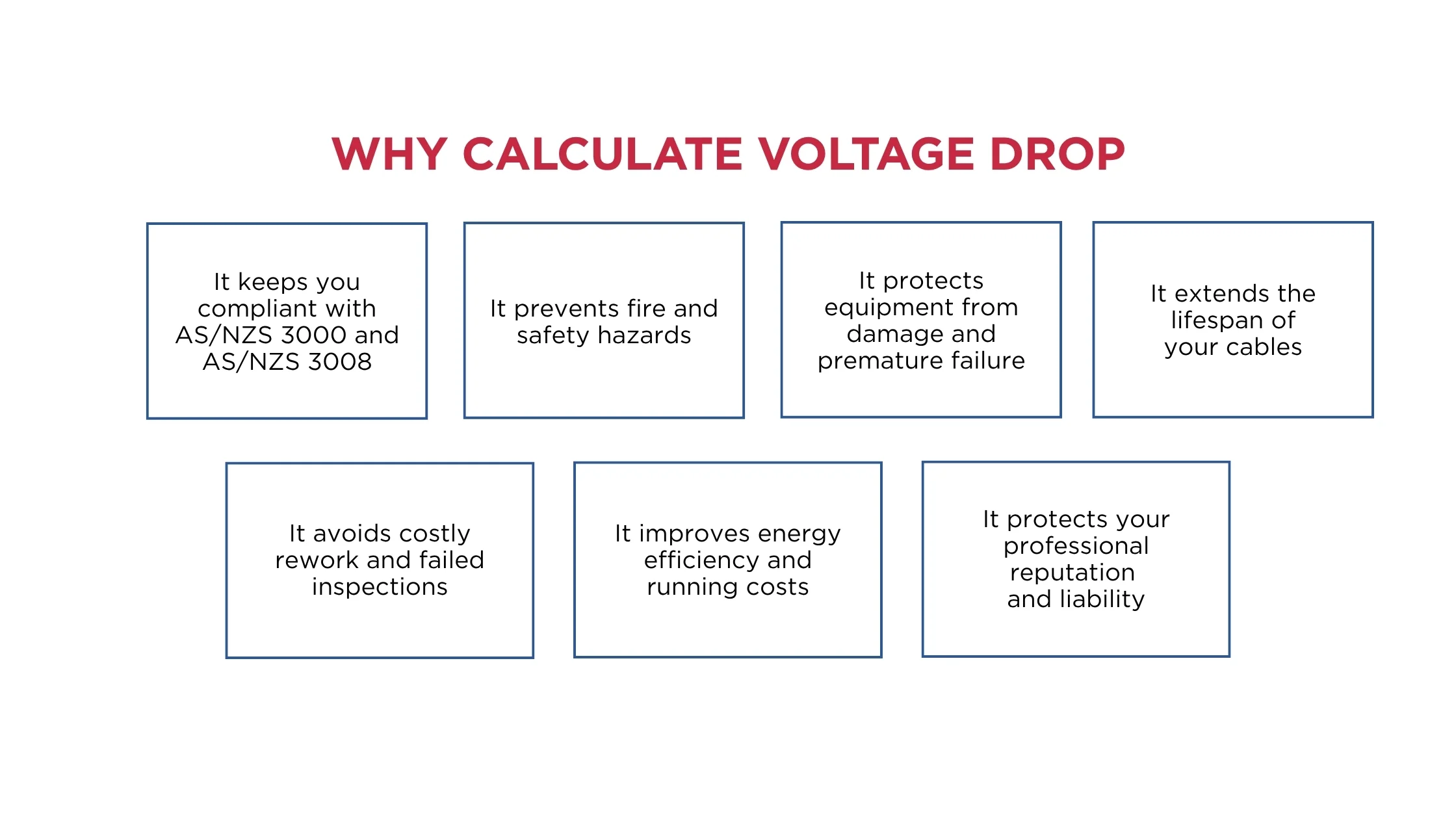
7 Important Reasons to Calculate Voltage Drop
It Keeps You Compliant with AS/NZS 3000 and AS/NZS 3008
Voltage drop isn't just best practice in Australia. It's a legal requirement.
Clause 3.6 of AS/NZS 3000:2018 sets the maximum allowable voltage drop at:
- Point of Supply to Any Point in the Installation: 5%
- Point of Supply from a Dedicated On-Site Substation: 7%
Design guidance under AS/NZS 3008.1.1 also supports typical sub-allowances of around 0.5% for consumer mains, 1.5–2% for sub-mains, and 2.5% for final sub-circuits.
A calculation is the only way to prove a design meets these limits, without it, you're relying on guesswork for something inspectors, certifiers, and clients will expect documented evidence of.
It Prevents Fire and Safety Hazards
Excess voltage drop generates excess heat. As resistance in an undersized or overloaded cable increases, that heat builds up in the conductor and insulation.
Over time, this can:
- Weaken and degrade cable insulation
- Cause conductors to arc against nearby materials
- Ignite insulation or combustible material near the cable
- Expose live conductors if insulation melts or tears, creating a shock risk
Calculating voltage drop before installation catches this risk at the design stage, long before it becomes a hazard on-site or in a finished building.
It Protects Equipment from Damage and Premature Failure
Motors, compressors, and other electrical equipment are built to run within a specific voltage range. When voltage drop pushes supply below that range, equipment compensates by drawing more current, which means more heat, more wear, and a shorter working life.
This is especially important for:
- Motors and compressors, which are highly sensitive to even small voltage losses
- HVAC systems, where undervoltage can trigger compressor lockouts or repeated cycling
- Electronic equipment, including LED drivers and control systems, which can malfunction or reset under low voltage
A correct voltage drop calculation ensures equipment receives the voltage it's designed to run on, protecting the client's investment in that equipment, not just the cable.
It Extends the Lifespan of Your Cables
Heat doesn't just threaten safety. It shortens the working life of the cable itself. Repeated thermal stress from excess voltage drop causes insulation to break down faster than it should, leading to cracking, melting, or complete insulation failure well before the cable's expected service life is up.
Calculating voltage drop correctly and sizing the cable accordingly means the conductor runs cooler, the insulation lasts longer, and the installation avoids an expensive, disruptive cable replacement down the track.
It Avoids Costly Rework and Failed Inspections
A cable sized without checking voltage drop can fail current-carrying capacity or compliance checks after it's already installed, meaning it has to be pulled out, resized, and reinstalled. On commercial and industrial jobs, that's lost labour, delayed handover, and a hit to the budget.
Calculating voltage drop upfront, before cable is ordered or pulled, is far cheaper than fixing a non-compliant installation after the fact.
It Improves Energy Efficiency and Running Costs
Voltage drop isn't just lost pressure. It's lost energy, dissipated as heat instead of delivered to the load. On circuits with significant drop, that waste adds up over the life of the installation, particularly on long runs or high-current circuits that operate for extended hours.
Calculating voltage drop and sizing cable appropriately reduces this energy loss, which translates to lower running costs for the end user over the installation's lifetime.
It Protects Your Professional Reputation and Liability
For electricians, designers, and engineers, a voltage drop calculation is also documentation. If a job is ever questioned, being able to show a compliant, calculated cable size is far stronger ground to stand on than "the cable looked big enough."
Getting it right the first time also means fewer callbacks, fewer client complaints about underperforming equipment, and a stronger professional track record.
What Happens When Voltage Drop Isn’t Calculated?
Skipping the calculation doesn't mean the problem disappears. It just means it surfaces later, usually in a more expensive or more dangerous form:
- Dimming lights and underperforming appliances reported by the client
- Motors and compressors failing well ahead of their expected lifespan
- Overheating cables and connections, with a genuine fire risk
- Failed compliance checks during inspection or certification
- Unplanned rework, replacing cable that should have been sized correctly the first time
Calculate Voltage Drop the Right Way with CableHero
Manually working through voltage drop calculations means:
- Cross-referencing AS/NZS 3008.1.1 tables for the right conductor type
- Applying temperature and power factor corrections
- Checking the result against AS/NZS 3000 limits
CableHero's cable sizing calculator does this automatically. Enter your load, cable length, and installation details, and CableHero calculates voltage drop, current-carrying capacity, and short-circuit performance in one compliant result.
Whether you're designing new work or double-checking an existing installation, getting the calculation right protects your client, your equipment, and your reputation.
Calculate voltage drop using CableHero for free.
FAQ
Why is it important to calculate voltage drop before choosing a cable size?
Calculating voltage drop confirms the cable will deliver enough voltage to the load while staying within the AS/NZS 3000 compliance limit. Without it, cable size is chosen on assumption, which risks equipment damage, safety hazards, and failed inspections.
What is the maximum voltage drop allowed under Australian standards?
AS/NZS 3000:2018 Clause 3.6 limits voltage drop to 5% of nominal voltage between the point of supply and any point in the installation, or 7% where supply comes from a dedicated on-site substation.
Can excessive voltage drop actually cause a fire?
Yes. Excessive voltage drop increases resistance-related heat in a cable. Over time, that heat can degrade insulation, cause arcing, and ignite nearby combustible material, which is why voltage drop limits exist as a safety measure, not just a performance one.


 Cable Sizing