Flickering lights. A motor that seems to have lost its punch. A breaker that trips for no obvious reason. These are common symptoms, and voltage drop is often the hidden cause behind.
Voltage drop electrical issues happen when too much voltage is lost as electricity travels through a cable, leaving equipment at the end of the circuit starved of power. Left unchecked, it doesn't just cause annoying glitches. It can shorten equipment lifespan, waste energy, and create genuine safety hazards.
This guide covers how to recognise voltage drop electrical issues, what causes them, how to test for them, and how to fix them for good, in line with the limits set by AS/NZS 3000:2018.
What Is Voltage Drop?
Voltage drop is the natural loss of electrical pressure that occurs as current flows through a conductor. Every cable has resistance, and that resistance "consumes" a small amount of voltage along the way.
The voltage available at the end of a circuit is always slightly lower than at the source. A small amount of voltage drop is normal and expected. It becomes a problem when the drop is large enough to affect how equipment performs, or when it exceeds the limits set by the Australian Wiring Rules.
Under
Clause 3.6 of AS/NZS 3000:2018, voltage drop between the point of supply and any point in a low-voltage installation must not exceed 5% of the nominal voltage (or 7% for installations supplied by a dedicated on-site substation).
On a 230V circuit, that's a maximum of 11.5V. Beyond that point, you're looking at a compliance issue as well as a performance one.
What Are the 7 Warning Signs of Voltage Drop Electrical Issues?
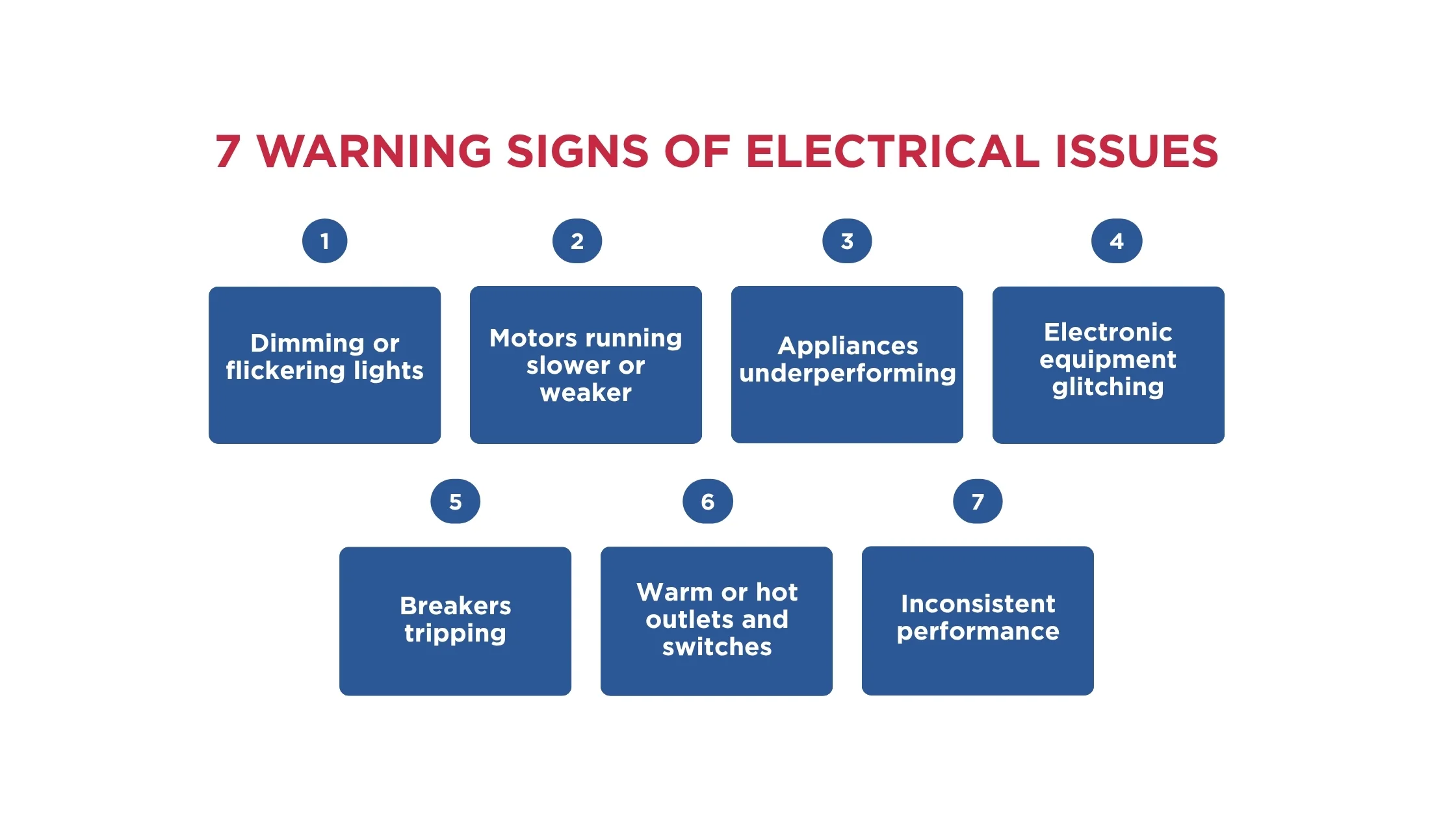
Voltage drop shows up as symptoms elsewhere in the system. Watch for:
- Dimming or flickering lights especially when a large appliance like an air conditioner or oven switches on
- Motors running slower or weaker than their rated performance
- Appliances underperforming, even though they're switched on
- Electronic equipment glitching or resetting unexpectedly, particularly sensitive devices like computers and LED drivers
- Breakers tripping without an obvious overload on the circuit
- Warm or hot outlets and switches, which can indicate excess resistance in the circuit
- Inconsistent performance in different rooms or zones, especially those furthest from the switchboard
What Causes Voltage Drop Electrical Issues?
Voltage drop is driven by three main factors, and most real-world issues come from one (or a combination) of these:
Cable Length
The longer the cable run, the more resistance the current has to push through, and the greater the voltage drop. This is why voltage drop electrical issues are more common in larger properties, sheds and outbuildings, and installations with long sub-main runs.
Undersized Cable (Wire Gauge)
Thinner cables have higher resistance than thicker ones. A cable that was adequately sized for the original load can become undersized if extra circuits, appliances, or extensions are added later without re-checking the calculation.
Excessive Current Load
The more current a circuit carries, the more voltage it loses along the way. Overloaded circuits, high-draw appliances on shared circuits, and equipment operating beyond its intended load all increase the risk of voltage drop electrical issues.
Other Contributing Factors
- Loose or corroded connections, which add unwanted resistance at joints and terminals
- Ageing wiring in older homes not designed for modern power demands
- Poor-quality or damaged cable insulation
- High ambient temperatures, which increase conductor resistance
How Are Voltage Drop Electrical Issues Fixed?
Once voltage drop is confirmed, the fix depends on what's driving it. Common solutions include:
- Upsize the Cable: A larger conductor has lower resistance, which directly reduces voltage drop. This is the most common and effective fix.
- Shorten the Cable Run Where Possible: Relocating a distribution board or switchboard closer to high-demand loads reduces the length current has to travel.
- Balance Loads Across Circuits: Spreading demand evenly prevents any single circuit from carrying more current than it should.
- Add Dedicated Circuits for High-Demand Appliances: Ovens, air conditioners, and hot water systems perform better on their own circuit.
- Fix Loose or Corroded Connections: Sometimes the fault isn't the cable at all, but a poor connection adding resistance at a joint or terminal.
- Upgrade Ageing Electrical Services: Older homes and buildings not designed for modern power demands often benefit from a full service upgrade rather than a series of individual fixes.
Before committing to any of these, run the numbers. A voltage drop calculator lets you test different cable sizes and lengths against the actual load, so you know which fix will bring the circuit back within the AS/NZS 3000 limit.
How to Test for Voltage Drop at Home or On Site
If you suspect voltage drop electrical issues, you can confirm it with a simple multimeter test. If you're not confident working around live circuits, call a licensed electrician instead.
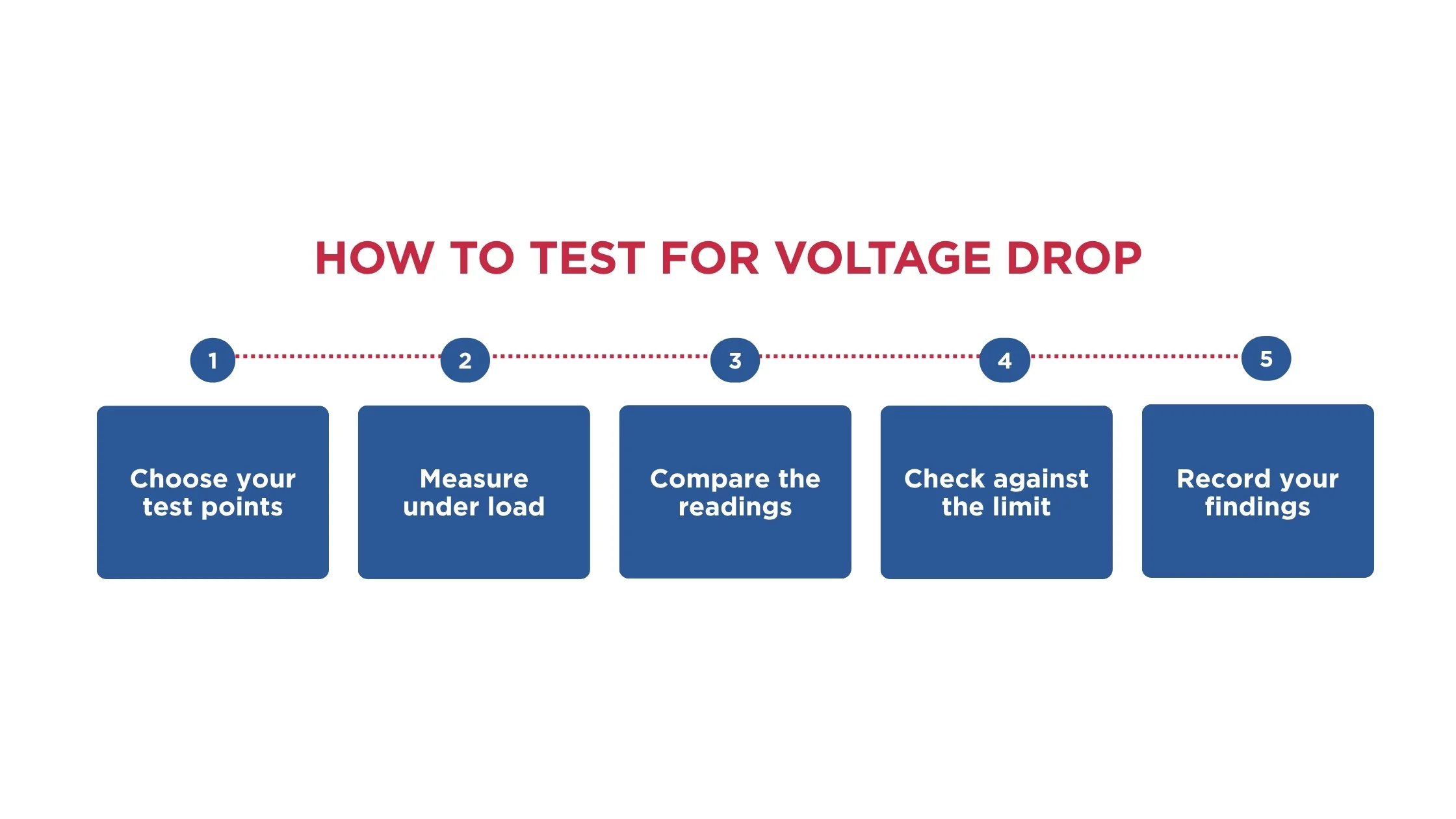
- Choose Your Test Points. Start at the service panel or switchboard, then test the outlets or equipment showing symptoms.
- Measure Under Load. Use a multimeter to record the voltage at the switchboard, then at the affected outlet, while the circuit is carrying its normal load (not idle).
- Compare the Readings. Subtract the outlet reading from the switchboard reading to get the voltage drop, then convert it to a percentage of the nominal voltage.
- Check Against the Limit. A result above 5% points to a wiring, sizing, or loading issue that needs attention.
- Record Your Findings. Note the readings, location, and circuit details. This makes it much easier for an electrician to diagnose the cause if further work is needed.
Safety Note: Always use insulated, rated test equipment, and never open a switchboard or test live circuits without the right training and PPE.
Why Does Ignoring Voltage Drop Electrical Issues Get Expensive?
Voltage drop that's left unresolved doesn't stay a minor annoyance. Over time it can lead to:
- Reduced Equipment Lifespan: Motors and appliances running under-voltage draw more current and generate more heat, wearing out faster
- Higher Energy Bills: Inefficient circuits waste energy as heat instead of delivering it to the load
- Increased Fire Risk: Excess heat at connections and undersized cables is a genuine safety hazard, not just a performance issue
- Compliance Failures: For new work, alterations, or certifications, non-compliant voltage drop can hold up sign-off and inspections
Catching and correcting voltage drop early is almost always cheaper than dealing with the downstream damage.
Calculate Voltage Drop Accurately with CableHero
Guessing at cable sizes is how voltage drop electrical issues slip through in the first place.
CableHero's cable sizing calculator lets you enter your current, cable length, and conductor details to get an accurate voltage drop result in seconds.
FAQ
What are the most common signs of voltage drop electrical issues?
The most common signs are dimming or flickering lights (especially when large appliances switch on), motors running slower than expected, electronic equipment malfunctioning, breakers tripping without an apparent overload, and warm outlets or switches.
How much voltage drop is considered a problem in Australia?
Under AS/NZS 3000:2018 Clause 3.6, voltage drop should not exceed 5% of the nominal supply voltage between the point of supply and any point in the installation (or 7% for installations with a dedicated on-site substation). On a 230V circuit, that's a maximum of 11.5V. Beyond that, it's considered a compliance and performance issue.
Can voltage drop damage my appliances?
Yes. Appliances and motors operating under low voltage draw more current to compensate, which generates extra heat and puts additional strain on components. Over time, this shortens equipment lifespan and can lead to premature failure.


 Cable Sizing